
Law Chambers of Nicholas Critelli, p.c.
Barristers and Trial Lawyers


Monday, July 16, 2007  


As a past receipient of the InnovAction Award, we at the Law Chambers of Nicholas Critelli, p.c., congratulate the new 2007 InnovAction Award winners:

The 2007 InnovAction Award Winners will be presented their awards on Saturday, September 8, 2007, during the Annual Meeting of the College of Law Practice Management in Philadelphia, PA. We would also be remiss if we did not acknowledge the many other firms that were in consideration to be an InnovAction Award winner:

Summaries of the above are well-worth reading.

The College of Law Practice Management was formed in 1994 to honor and recognize distinguished law practice management professionals. In 2004 the Law Chambers of Nicholas Critelli, p.c. was recognized by the College and its co-sponsor, the Microsoft Corporation, for our innovative action in improving firm efficiency with our receipt of the 2004 InnovAction Award. You can learn more about our Chambers and our unique practice by watching our

Office Video.

posted by Tre | Monday, July 16, 2007


Friday, June 15, 2007  

Enforcement of Foreign Money Judgments in the United States

Thanks in large part to the Internet, more US-based businesses are getting involved in international transactions than ever before. While there are certainly many benefits to such transactions, there are also detriments. Key among them is what happens when the US-based company fails to pay its bill. Whilst bringing a lawsuit against the US-based company in its home state is usually the best option, at times it may not be practical. In such circumstances it may be necessary to obtain a judgment against the US-based business in the local, non-US court system. But will such a judgment be enforceable?

In many states, the enforcement of non-US based court judgments is governed by the Uniform Foreign Money-Judgments Recognition Act. See e.g. Iowa Code §626B . Pursuant to the terms of the Act, a foreign judgment which is final and conclusive is enforceable in the same manner and to the same extent as a judgment from another state in the United States. A judgment is deemed final when the time for an appeal in the foreign state has expired or all appeals are exhausted. Non-final foreign judgments may be filed but the defendant can request the court stay the proceedings. A judgment is conclusive between the parties to the extent that the judgment grants or denies recovery of a sum of money.

A foreign judgment is not conclusive in any of the following cases:

a. When the foreign judgment was rendered under a system which does not provide impartial tribunals or procedures compatible with the requirements of due process of law;

b. Except in certain circumstances, when the court of the foreign state did not have personal jurisdiction over the defendant, or

c. When the court of the foreign state did not have jurisdiction over the subject matter involved in the action.

As noted above, personal jurisdiction over the defendant is not always needed. Lack of personal jurisdiction is not a barrier if any of the following have occurred:

a. If the defendant was served personally in the foreign state;

b. If the defendant voluntarily appeared in the proceedings, other than for the purpose of protecting property seized or threatened with seizure in the proceedings or for the purpose of contesting jurisdiction of the court in the foreign state over the defendant;

c. If the defendant, prior to the commencement of the proceedings in the court of the foreign state, had agreed to submit to the jurisdiction of that court in the action concerning the subject matter involved;

d. If the defendant was domiciled, had its principal place of business, or otherwise had acquired corporate status in the foreign state when the proceedings were instituted;

e. If the defendant had a business office in the foreign state and the proceedings in the court of the foreign state involved a cause of action arising out of business done by the defendant through that office in the foreign state; or

f. If the defendant operated a motor vehicle or airplane in the foreign state and the proceedings involved a cause of action arising out of that operation.

The fact that the foreign judgment is final and conclusive does not mandate that it be recognized. If any of the following are applicable, recognition of the foreign judgment is discretionary by the court:

a. The defendant in the proceedings in the court of the foreign state did not receive notice of the proceedings in sufficient time to enable the defendant to defend against the action;

b. The foreign judgment was obtained by fraud;

c. The cause of action on which the foreign judgment was based is contrary to the public policy of this state;

d. The foreign judgment conflicts with a previous, final, and conclusive foreign judgment or other judgment;

e. The proceeding in the foreign court was contrary to a settlement agreement entered into between the parties prior to the foreign judgment’s being rendered by the court in the foreign state; or

f. The court where the plaintiff is seeking to enforce the foreign judgment determines that jurisdiction in the court of the foreign state was based upon personal service only, and the doctrine of forum non conveniens applies to the original action.


As the saying goes, forewarned is forearmed. Presuming your clients are located in a jurisdiction which has impartial tribunals and procedures compatible with the requirements of due process of law as interpreted by most common-law jurisdictions, we would suggest you advise your clients to add a forum selection clause to their contracts, by which the US-based business agrees to submit to the jurisdiction of the local, non-US court in the action concerning the subject matter involved. Such a clause, when coupled with proper service of process in sufficient time to enable the US-based company to defend against the action, will substantially increase the likelihood of the enforcement of any non-US based court judgment within the United States.

posted by Tre | Friday, June 15, 2007


Monday, September 12, 2005  


Article of the week from Lawyers Weekly USA
November 1, 2004: Law Firm Thrives With Non-Traditional Office
By Abigail Klingbeil

There are no corner offices at The Law Chambers of Nicholas Critelli in Des Moines, Iowa. In fact, there are no offices at all.

The law firm, which is dedicated to litigation and ADR, has divided its space into function areas, such as its Studio C, a room designated for preparing pleadings and briefs. The firm's two attorneys, Nick Critelli, 60, and his son, Tré Critelli, 38, unload their keys, briefcases and other personal items on a tall desk in the corner of the library. The office manager - the only person in the firm with a designated seat - leaves phone messages and personal mail there.

The Critellis work inside whichever room has the tools necessary for their current task. If Tré Critelli is preparing a PowerPoint presentation for court, he'll be in Studio A, the Digital Media Studio, which has computers, a laser printer and video equipment. If Nick Critelli is entering documents into CaseMap, a software program that helps organize cases, you'll find him in Studio B, which has four computer monitors and a bookshelf lined with reference materials.

"The nature of our clientele and the nature of our services is something that really lends itself to this setup," Tré Critelli said.

Which brings us to the other unique aspect of Critelli's law firm - both father and son are barristers, having passed the bar in England as well at the United States. Following the British model, in which barristers try cases and solicitors conduct pretrial discovery and pleadings, the Critelli's work almost exclusively for other lawyers, rather than directly for clients. Their role, often as local counsel for large national law firms, is to help other lawyers prepare and argue cases for trial, mediation or arbitration. This is where space mirrors function. Because the firm does not take walk-in clients, it does not need formal spaces for introductory meetings. It is more important, they say, to have all the tools at their disposal for whatever specialized piece of the litigation process they are working on at the moment.

Technology is an important part of the arrangement. Each room is wired with an internal video cable network. All documents are scanned, resulting in a paperless environment. Through the Internet, the whole system can be accessed from afar.

The College of Law Practice Management recently honored the law firm with a 2004 InnovAction Award. The firm won one of two awards in the "Leader Ships" category, which is sponsored by Microsoft Corp. and recognizes firms that have taken "the most innovative action toward improving their internal management or firm efficiency."

A Radical Concept

The Critellis believe that their setup helps their courtroom approach. They have used a no-office arrangement since they moved into new space on the 9th floor of an office building in 2001. Before constructing the current offices, the firm was in more typical law firm space, with personal offices. When they decided to move and design new offices, they asked themselves a simple question: "How can we do what we do more efficiently?" As trial attorneys and barristers, the Critellis view themselves as specialists, with specific tasks to perform for their clients.

In designing the office space, they identified several tasks that require special tools and layout, and designed rooms to fulfill those needs. The setup allows for maximum efficiency, Tré Critelli said. "By having independent studios for the different tasks, it allows me to focus on the task that I am performing," he said. "For example, if I'm doing legal research, I'm in the research room. And all of my tools are there. I can shut the door, turn off the phone, have my calls held and I have the complete luxury to devote myself to that one task."

The setup is also conducive to having outside attorneys spend extended periods of time in the offices, Tré Critelli said. It's a fairly common occurrence, since out-of-state law firms regularly hire the firm as local counsel for cases they are trying in Iowa.

As part of its Anglo American Exchange, the Critelli firm hosts a barrister for six to eight weeks each summer to learn about the U.S. legal system. With the no-office setup, the firm can accommodate extra attorneys without having extra rooms. If two attorneys want to use the same room, they reserve blocks of time on a sign-up sheet. In addition to the studios, the Critellis incorporated a legal research room with books to help then identify legal issues. They have a production studio, with scanners, poster-makers and binding equipment. The space also has a large conference room that can be used for a number of purposes. "That has modular furniture if we want to set it up as a mock trial, courtroom," Tré Critelli said.

A View From The Outside

Barry Reingold, 53, a partner at Perkins Coie in Washington, D.C., worked in the law offices for several weeks last year, while preparing to try a case in Cedar Rapids, Iowa. "You walk in here and you see this is sort of like a surgeon's operating room," with specialized tools for specific tasks, Reingold said. "I've never really had those sorts of facilities available," he said. "We spent a lot of time preparing a case and doing a mock trial, and the video capability was very useful," he said.

While the mock jury conferred in one room, he was able to watch them from another. Reingold said many law firms hire companies to conduct mock trials, which often take place in hotels or other outside spaces. Reingold said he also found the firm's War Room, Studio D, useful. One wall is floor-to-ceiling shelves with electronic equipment, a digital projector, televisions and VCR. Two walls of the room are made of a white material that can be written on. Lawyers literally can sketch out strategy, then erase and rewrite. "It invites a lot of visual thinking." Reingold said. "So often, lawyers just sit around an office and talk to each other. It invites you to think visually or graphically and in that sense more creatively."

Reingold invoked a medical analogy again in describing how the Critellis' specialization in trial law distinguishes them from other lawyers. "Their mindset is very different - probably more like a surgeon [who is] trained to accomplish specific results, rather than an internist, who can diagnose, look at tests. It's a different set of skills," Reingold said. He said Nick Critelli, with whom he partnered as a trial lawyer for a case last year, has a "very tightly organized approach to the presentation of the case, which I think reflects a barrister's training."

White Wigs And Trial Training

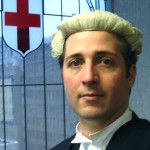
Tré Critelli said becoming a barrister provided him with training in trial advocacy, something that few American law schools provide. He and his father, who is president of the Iowa State Bar Association, can argue cases in England, as well as the 53 British Commonwealth nations. The firm has two England-based associates. For example, during his internship - known as a pupilage in England - Tré Critelli argued a case in Gibraltar about whether women should be required to serve on juries. His team won in a 3-2 decision. Nick Critelli decided to become a barrister in the mid-1980s after attending an American Bar Association annual meeting in London.

During the meeting, Critelli, who was then president of the Iowa Academy of Trial Lawyers, spent time watching a trial inside a British courtroom. "I watched these guys in wigs and robes doing what I do every day a heck of a lot better than I've ever seen anybody do it," he said. "They could do a cross-examination with style and power in 20 minutes that would take the average American six hours. When I went back I just couldn't get it out of my mind and [decided that] I had to learn how to do that. I couldn't go back into an American courtroom doing what I was used to doing after seeing that." Critelli contacted the English bar to see if he could take law classes in England. He was admitted into an English law school where he took classes over the next four years, passed his exams and was admitted into the English bar. He then began a year-long pupilage, or internship. "Law schools teach you the why of the law and the pupilages or the internships teach you the how of the law. I was in court everyday with some of the best lawyers in the world," he said. After the pupilage, Critelli returned to Des Moines, transformed by his experience. "It allows us to deal with extremely complex cases in a methodical way. It's not only the training as a barrister but also the use of technology," he said. "We've taken the training and the advocacy skills that we've been exposed to in the U.K. and the technology we have on this side [of the Atlantic] so we can handle much more complex cases quicker." He said about 60 percent of the practice's cases are a direct result of their dual qualification. They have dealt with cases involving international disputes about insurance and intellectual property. Nick Critelli said he is often called upon to give testimony in the United States as an expert witness in English law and in England as an expert in American procedure.

Not For Everybody

Both Tré and Nick Critelli, amateur radio operators, are technophiles. They set up the networking equipment, which they purchased at CompUSA. "Too many people have computer systems they don't understand," Tré Critelli said.

The firm kept things simple by choosing a standard operating system, Windows XP, and using only Gateway computer systems. Before embarking on the project, the Critellis had considered several different designs, including one where each attorney had an office and an adjoining conference room.

"What we found is if you have one desk, like most law offices, you don't have all the tools you need in your general desk area." And that's how they honed in on this function-based design. They have shown the setup to a number of other attorneys, some of whom have decided to incorporate certain aspects into their own practices.

Inspired by the Critelli office, The James Law Firm PC, also in Des Moines, decided to go paperless. "We've been interested in technology to make our practice easier," said Fredrick W. James, one of the three attorneys at the firm. Another lawyer at the firm set up a document management system after conferring with Tré Critelli. "Now, when you travel to take depositions, where you used to have to take literally banker boxes of material, you can now take them on your computer," James said. "We scan every piece of mail that comes into our office - correspondence, pleadings, medical records," which are then e-mailed to their intended recipients, James said. "I don't receive paper anymore." But James doesn't have plans to adopt the office-less arrangement. "I still like coming to my traditional office. I like a place where I can have some pictures of my family and a place that I can call my own," he said.

(c) Lawyers Weekly USA

posted by Nick | Monday, September 12, 2005


Virtual Law Office

In an effort to keep our clients fully engaged in the processing of their legal matter, we have created the concept of a virtual law office.

Clients may enter the virtual office at any time, receive an update on their case or matter and enter into discussion or dialogue regarding their case. They can also access deadlines, documents, video presentation and other matters of importance.

If you are a client and have received your user name and password, you may enter our virtual office by clicking on the following link:

Enter the CritelliLaw Virtual Office


If you are not a client but would like a tour of the virtual office, you may click on the following link. Your username is "virtual" and your password is "office". If you would like further information concerning the virtual office, please call us at (515) 243-3122

Tour of CritelliLaw Virtual Office


Virtual Conference Room

In addition to the Virtual Law Office, we also host a Virtual Conference Room wherein clients may attend case briefings. Please obtain your log-in info from us prior to accessing our Virtual Conference Room.


Enter the CritelliLaw Virtual Conference Room


About our Chambers
how to contact us
more about us
Iowa State Bar Association
required disclaimer